
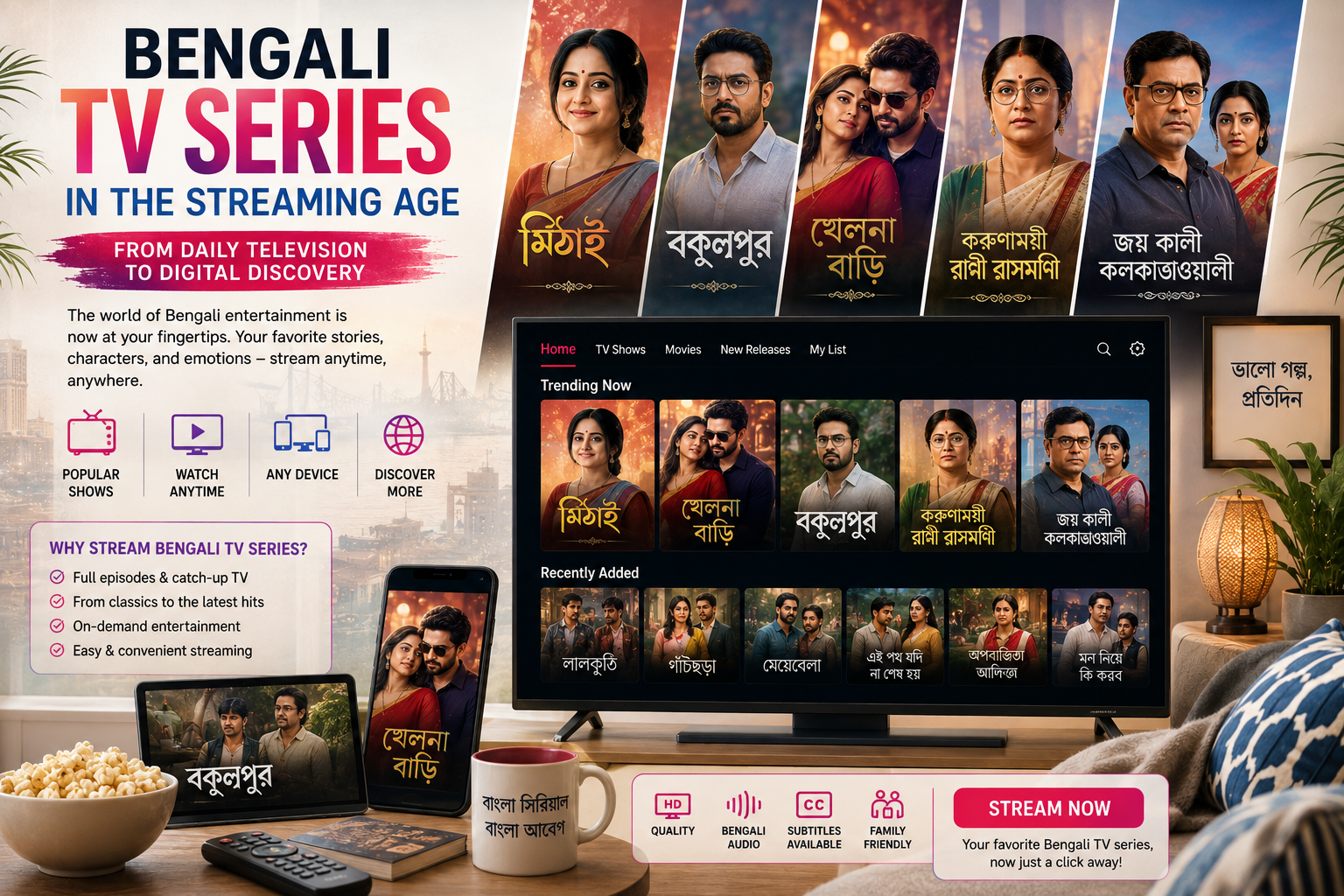
Bengali TV Series in the Streaming Age: From Daily Television to Digital Discovery
Bengali television has grown far beyond the traditional living-room schedule. Today, Bengali-language episodic entertainment exists across conventional TV channels, digital libraries, and dedicated streaming services, creating a much wider environment for audiences to explore. The contemporary Bengali series landscape includes long-running television dramas as well as shorter web series designed around on-demand viewing. For audiences interested in বাংলা টিভি সিরিজ, the digital format offers a practical way to discover Bengali episodic entertainment without having to organize everyday routines around a broadcaster’s timetable.
From Evening Broadcasts to Always-Available Episodes
Traditional Bengali television has historically been built around recurring programming. Audiences become familiar with particular time slots, follow continuing shows, and organize parts of their evening around scheduled episodes. Digital streaming has introduced a different rhythm. Instead of waiting for a program to appear at a fixed hour, viewers can approach episodic entertainment when they actually have time for it.
This shift is particularly significant because series are naturally suited to repeated viewing. A television movie may occupy one evening, but a series can become part of a longer viewing routine, with audiences returning to the same catalog over days or weeks. Online access makes that relationship more flexible by allowing viewers to choose when to begin and when to continue.
Current Bengali streaming catalogs demonstrate how broad this environment has become. ZEE5, for example, separates Bengali web series into categories including drama, thriller, comedy, romance, action, suspense, mystery, sports, children’s programming, and period drama. This variety shows how Bengali episodic entertainment has developed into a much broader category than traditional daily television alone.
The New Geography of Bengali Episodic Entertainment
Bengali series have an unusual geographic reach because Bengali-speaking audiences are spread across Bangladesh, West Bengal, and a substantial international diaspora. Digital distribution makes this audience less dependent on local television infrastructure and creates a common environment where Bengali-language programming can be discovered from different parts of the world.
The distinction between television series and web series has also become less rigid. Traditional Bengali television continues to produce ongoing drama and other serial formats, while streaming platforms have expanded the language’s presence in shorter, genre-focused productions. Current digital catalogs include both established television-style entertainment and newer web-series formats, demonstrating how the two models now coexist.
This development has particular importance for Bengali viewers living outside the region. A television schedule designed for audiences in Kolkata or Dhaka may not correspond with the daily routine of someone living in London, Dubai, Toronto, or another international city. Online access removes much of that scheduling problem by allowing the viewer to decide when an episode fits into the day.
Why Genre Variety Has Become Central to Bengali Series
The contemporary Bengali series catalog is increasingly defined by genre diversity. Drama remains an important part of the landscape, but viewers can also find crime, thriller, suspense, romance, comedy, action, mystery, sports, children’s entertainment, and period formats. ZEE5’s current Bengali catalog illustrates this expansion, with dedicated sections for several of these categories rather than treating Bengali episodic content as one uniform genre.
This matters because episodic entertainment depends heavily on discovery. A viewer may want a serious drama one evening and something lighter the next. A large digital catalog can accommodate these changes without requiring the audience to move between completely different viewing systems.
The organization of content therefore becomes almost as important as the quantity of content available. Clear genre shelves and intuitive categories help viewers understand what a platform offers before they commit to a series. Instead of scrolling through an endless chronological feed, audiences can begin with a familiar category and explore from there.
For newcomers to Bengali television, this structure also makes regional entertainment easier to approach. They do not need to know the names of individual shows beforehand. A genre or format can provide the starting point, with the catalog gradually introducing them to the wider Bengali television ecosystem.
Television Serials Meet the Web-Series Generation
One of the most interesting developments in Bengali entertainment is the coexistence of traditional television serials and newer web-series formats. Television continues to support long-running episodic programming, while streaming has encouraged more compact seasons, genre experimentation, and formats designed specifically for digital audiences.
This transition reflects a wider change in viewing habits. Audiences accustomed to on-demand entertainment increasingly expect greater control over when they watch and how quickly they move through a series. Streaming makes it possible to approach episodes according to personal availability rather than a broadcaster’s predetermined rhythm.
Recent Bengali streaming activity illustrates this continued evolution. Industry coverage in 2026 has reported new Bengali series arriving on platforms such as Hoichoi and ZEE5, while other Bengali OTT releases have demonstrated that the digital ecosystem continues to develop alongside conventional television.
The result is not necessarily the disappearance of television. Instead, Bengali episodic entertainment is becoming a hybrid environment in which traditional serial formats and digitally produced series can reach audiences through increasingly similar screens.
A Better Way to Navigate Long-Form Entertainment
The difference between a useful series catalog and a frustrating one often comes down to navigation. Movies can be selected individually, but television series contain multiple episodes, seasons, and sometimes different formats within the same title. The interface therefore needs to make continuation as straightforward as discovery.
Digital shelves can help by separating series according to genre, popularity, recency, or other meaningful categories. Episode pages can then provide a clear route into playback without forcing viewers to repeatedly search for the next part of a series.
This is where a frictionless experience becomes particularly valuable. Moviewala’s catalog-oriented approach allows viewers to explore Bengali entertainment directly, choose a series from the available shelf, and move toward playback without unnecessary registration barriers. There is no need for the first interaction to become an account-management exercise, while an interface without annoying pop-ups keeps the focus on the programming.
Direct access also makes casual browsing easier. A viewer can explore several Bengali series before deciding which one fits the moment, rather than committing to a title simply because the platform has made everything else difficult to reach.
Bengali Series on the Screen of Your Choice
The television set remains an important destination for Bengali episodic entertainment, particularly for families and longer viewing sessions. However, the digital environment has expanded the range of screens through which audiences can access series. Laptops, tablets, smartphones, and connected televisions have all become part of the modern Bengali viewing experience.
This matters for international audiences in particular. A Bengali-speaking viewer may watch a series on a Smart TV at home but rely on a smartphone or laptop at another time. A flexible online catalog allows the same type of entertainment to fit different circumstances instead of tying it to one physical device.
Interface design needs to account for this variety. Large-screen browsing should feel spacious and clear, while mobile navigation needs to remain compact and responsive. Episode selection, category navigation, and playback controls should be understandable regardless of the screen being used.
The ideal experience makes the transition between devices feel unremarkable. The audience changes the screen; the entertainment remains accessible.
What Makes Streaming Episodic Content Reliable
Behind the apparent simplicity of online Bengali series is a considerable technical infrastructure. Episodic video still requires substantial data delivery, and platforms need to support viewers using different devices and connection speeds. Cloud infrastructure, distributed content delivery, video compression, and adaptive streaming all contribute to keeping playback stable.
Compression technology allows detailed video to be transmitted using manageable amounts of data, while adaptive playback can adjust to changes in available bandwidth. These processes are particularly important when a platform serves audiences across several regions with very different internet conditions.
The infrastructure also needs to handle repeated viewing patterns. Unlike a single movie session, a series can generate multiple visits as viewers return for additional episodes. Efficient content delivery therefore supports not just individual playback but the continuity of an entire viewing routine.
For the audience, all of this complexity should remain invisible. The desired experience is simple: select a Bengali series, open an episode, and watch without unnecessary interruptions.
The International Future of Bengali TV
Bengali episodic entertainment is increasingly part of a global digital culture. Dedicated Bengali streaming services have explicitly positioned themselves for audiences both in India and across the Bengali diaspora, while broader OTT platforms now organize Bengali programming alongside content in other Indian languages.
This internationalization gives Bengali television a larger potential audience without requiring it to abandon its linguistic identity. Bengali remains the foundation of the content, while digital distribution provides the infrastructure needed to move it beyond traditional geographical boundaries.
The growing availability of current productions also means that audiences abroad can remain more closely connected with developments in Bengali entertainment. Instead of depending on occasional television broadcasts or imported media, viewers can return to a digital catalog and explore what is currently available.
As streaming technology develops further, this connection is likely to become even more seamless. Better playback, broader device support, smarter catalog organization, and improved discovery systems can make Bengali episodic entertainment easier to navigate without making the interface more complicated.
A More Flexible Era for Bengali Series
The future of Bengali TV series is unlikely to belong exclusively to either traditional television or streaming. Both formats now occupy different but overlapping roles, with television continuing to support long-running serial entertainment and digital platforms expanding the possibilities for web series, genre experimentation, and international access.
For viewers, the most important change is control. They can decide when to explore a series, which category to browse, which screen to use, and how a viewing session fits into the rest of the day. A digital catalog transforms Bengali episodic entertainment from something tied to a timetable into something that can adapt to individual routines.
The experience can remain deliberately simple: open the Bengali entertainment catalog, explore the available series, choose a title from the shelf, select an episode, and press play. With high-quality playback, direct access, no registration wall, and no distracting pop-ups interrupting discovery, the technology can stay in the background while Bengali television and web entertainment take the foreground.